

Andrewes exercised considerable influence for many years both in the Church of England and at court. He served as chaplain to the Archbishop of Canterbury, as well as to Queen Elizabeth I. Although Andrewes was offered two positions as bishop under Queen Elizabeth I, he turned them both down. He continued to be held in high regard during the reign of King James I and finally succombed to ordination as a bishop in the Church, becoming Bishop of Chichester in 1605, of Ely in 1609, and of Winchester in 1619. In 1616, he narrowly missed becoming the Archbishop of Canterbury.
Lancelot Andrewes was a brilliant scholar. It is said that he was fluent in fifteen languages, and that he might “have served as an interpreter general at the confusion of Tongues,” or Pentecost. It makes perfect sense, then, that he was one of the scholars appointed to produce the Authorized Version of the Bible, or the King James Version as it has come to be known.
In Andrewes’ own life, much of his fame came from his sermons; he preached regularly at court on high feast days such as Christmas, Easter, and Pentecost. His sermons reveal a depth in the biblical text that few preachers ever dig long enough or thoroughly enough to reach. T.S. Eliot said of Andrewes’ sermons: “Andrewes takes a word and derives the world from it; squeezing and squeezing the word until it yields a full juice of meaning which we should never have supposed any word to possess.”[1] A book of 96 of his sermons was published in 1628 and remains an Anglican classic.
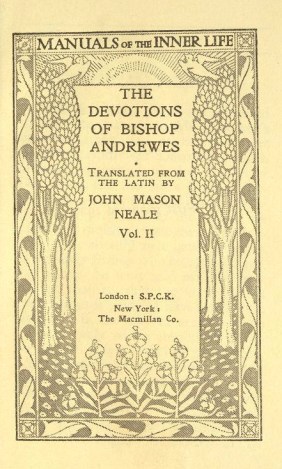
But let us not imagine in Andrewes only a dry, cerebral faith. It is important to note that Andrewes is also well known for his spiritual purity and dedication. Preces Privitae (or Private Devotions) is a collection of his own personal devotions composed mainly in Greek, a window into the five hours each day the bishop is said to have spent in prayer. Some claim that his silent instensity, simplicity, and ascetic habits caused even the King and members of court to curtail their questionable behavior when he was present.
Lancelot Andrewes died on September 25, 1626 at Southwark in Surrey.
What can we as the Church learn from this bishop, scholar, homiletician, and devoted Christian? Anthony D. Baker, Professor of Systematic Theology at Seminary of the Southwest, has suggested that one of the most revelant practices the Church can learn from Lancelot Andrewes today is how to live with one another in the midst of turmoil. Many theological controversies were brewing during the lifetime of Andrewes. The Church of England was defining itself in relationship to Puritanism on one hand, and Roman Catholicism on the other. Andrewes did not attempt to steer clear of the hot button issues. and sometimes he even entered into the heart of debates. But he did so reluctantly. In one of his sermons, he said the following: “Those [points of religion] that are necessary [God] has made plain; those that are [not] plain, [are] not necessary…. A way of peace, then, there shall be, whereof all parts shall agree, even in the midst of a world of controversies.”[2] Granted, this may seem overly simplistic, especially when the world is ever-changing and what is, in scripture, plain to one Christian may not be plain to another. It remains, however, worth asking this question: if Andrewes calls for a lack of concern for those things which are not essential, then what are those points of doctrine which he considers to be essential?
For Andrewes, the essentials of the Christian faith seem to be the Mysteries themselves—the Incarnation, the Resurrection, the coming of the Holy Spirit at Pentecost—the events through which God enters into the history of the world so that the world might be transformed. His sermons always bring us face to face with such mysteries, and they end by directing us towards the Eucharist. Instead of allowing himself to be completely enveloped by the ecclesiastical controversy of the day, Lancelot Andrewes remains focused on the way God is revealed through the mysteries of faith, a revelation that—as does each of our Sunday services—begins in scripture and finds fulfillment in Eucharist (in encounter). As Anthony Baker writes, Lancelot Andrewes seems to acknowledge that
…as dense and mysterious and seemingly impenetrable as its pages may be, scripture does indeed “containeth all things necessary for salvation,” and we will never do better than to search its figures and phrases with the utmost care. Anglicanism is, above all, for Andrewes, a practice of patience. For playing in the mysteries, encountering the Risen Christ in the ancient faith, and allowing that encounter to change our questions, to transform our minds and imaginations, this is his Anglicanism; indeed, this is the entire gospel, according to Lancelot Andrewes.[3]
I can’t help but believe that, even today, this is where we in the Church must begin and end—immersing ourselves in the Mysteries, working out our salvation with patience, encounter, imagination, and a willingness to be transformed over and over again.
[1] T.S Eliot, For Lancelot Andrewes: Essays on Style and Order (Faber and Gwyer, 1928) 24.
[2] Lancelot Andrewes, Sermon III of the Nativity: Christmas 1607, in The Library of Anglo-Catholic Theology, Volume I: Sermons, Lancelot Andrewes, edited by John Henry Parker (Oxford, 1842) 35.
[3] I am indebted for my love of Lancelot Andrewes to Tony Baker, for whom I researched citations for line upon line of Andrewes’ sermons while working as his assistant at the Seminary of the Southwest. This quotation comes from a presentation he gave entitled “Preaching the Gospel in a Polarized Church, or For Lancelot Andrewes (Once More, with Feeling),” a presentation given at the Seminary of the Southwest in the Spring of 2006.
 An Honest Hope