
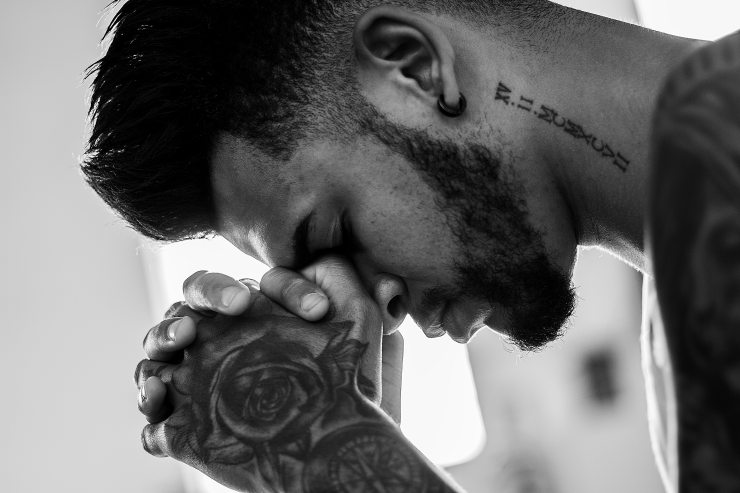
The word of the Lord came to Abram in a vision, “Do not be afraid, Abram, I am your shield; your reward shall be very great.” But Abram said, “O Lord God, what will you give me, for I continue childless, and the heir of my house is Eliezer of Damascus?” And Abram said, “You have given me no offspring, and so a slave born in my house is to be my heir.” But the word of the Lord came to him, “This man shall not be your heir; no one but your very own issue shall be your heir.” He brought him outside and said, “Look toward heaven and count the stars, if you are able to count them.” Then he said to him, “So shall your descendants be.” And he believed the Lord; and the Lord reckoned it to him as righteousness.
Genesis 15:1-6*
When my daughter Emma was three years old, she woke up in the middle of the night with a wicked stomach virus. After the sheets were put in the washer and Emma was put in the tub, we settled back down to wait for the next wave. Emma said, “Mommy, we need to say our prayers.” My tired response was, “We’ve already said a bedtime prayer, but we can say another one.” Emma replied, “But this time will you ask that I not get sick again.” We said our prayer, and within twenty minutes we were back out of bed again. As my husband commented at the time, it was now time for Emma to learn the deeper meaning of prayer. And so began Emma’s own divine conversation with God, her journey of faith at the ripe old age of three. I knew that this experience would, God willing, be just one moment in what would go on to be a rich, complicated dialogue with God that would last her whole life through.
In today’s Old Testament reading we get to hear a sound bite of Abraham’s journey of faith. Abraham is known as the Father of Faith – in fact, he holds this distinction in three world religions, the Abrahamic faiths of Judaism, Christianity, and Islam. It’s no small honor. And yet Abraham’s faith wasn’t as sharp and clear as we often think. It wasn’t as if once Abraham received a divine truth that he believed it without any wavering from that day forward. From what we read in scripture Abraham’s faith was more complicated than that. Just look at Abraham’s faith story in the book of Genesis.
In the twelfth chapter of Genesis, God comes to Abraham and says: “Go from your country and your kindred and your father’s house to the land that I will show you. And I will make you a great nation.” Abraham goes, but he takes his nephew with him. After Abraham and Sarah arrive in the land of Canaan, the land God has promised them, a famine strikes. We don’t hear of Abraham and Sarah asking for God’s help or guidance in this situation, we just read that they left the land God had given them and went down to Egypt. When they get to Egypt, Abraham tells everyone that the beautiful Sarah is his sister and not his wife, so that no one will kill him in order to marry Sarah. When Sarah is taken into Pharaoh’s home because of her beauty, it is God who sets things straight, inflicting plagues on Pharaoh and his household until Sarah is released. Not exactly the portrait of a person full of faith in the way we often think of faith.
In today’s passage from Genesis, the Lord comes to Abraham in a vision and says: “No one but your very own child shall be your heir. Look at the stars – this is how numerous your descendants will be!” And Abraham believes him, and the Bible tells us the Lord reckoned it to him as righteousness. Then, in the very next verse following today’s gospel reading, God says to Abraham: “I am the Lord who brought you from Ur of the Chaldeans, to give you this land to possess.” And we hear from Abraham: “So how am I to know that I am to possess it?” In other words, I believe you about the son that will be born to my almost one hundred year old wife, but I’m going to need some proof when it comes to the land.
Later in the sixteenth chapter of Genesis, when Sarah still hasn’t had a child after years of waiting for God’s promise to be fulfilled, Sarah comes up with a plan that Abraham should have children with her handmaid, Hagar. Ishmael is born. Once again it seems that Abraham and Sarah have taken matters into their own hands, following the adage that “God helps those who help themselves.”
When three mysterious men visit Abraham in chapter eighteen and tell Abraham that Sarah will bear a son, Sarah laughs outright. When Sarah does bear a son and he grows and matures, when he becomes the apple of his parents’ eyes, Abraham makes the hard trip up Mount Moriah to do the unthinkable, to sacrifice Isaac like God commands him to. That part of Abraham’s faith story haunts us; we hardly know what to do with it. The truth is that from what we read in scripture, Abraham’s faith seems to be a strange mixture of the heroic and the cowardice, of certainty and skepticism.
If Abraham is the poster boy for faith, then perhaps faith isn’t what we usually understand it to be. Faith isn’t just believing something once and for all and never questioning it. For the most part, faith isn’t believing at all. It is not a set of propositions that one deems to be true or false – like the Trinity, or original sin, or the ascension. [1]
Faith is a relationship, so part of what it means to be faithful is simply to be willing to remain in dialogue with the other party – day in and day out. If that’s faith, then Abraham was faithful over and over again. His whole life was one long conversation with God – sometimes trusting absolutely, sometimes being a little skeptical, but always willing to at least take part in the dialogue.
But we can’t just leave it there, stopping with Abraham’s faithfulness – that’s only half the story. Truth be told, it’s far less than half the story. Because while Abraham’s trust in God was hit and miss, God’s faithfulness to Abraham never wavered. It’s a bond that we’ll see again and again in the history of Israel and in the history of the world. Israel may leave the dialogue, she may walk away from the table now and then, but God never does. God is always faithful to that relationship, and God is always faithful to us.
In my Baptist church growing up, the Holy Spirit would occasionally take over a carefully planned service. The pastor would finish preaching and immediately someone would unexpectedly stand up in the pews or choir loft and start telling their own story of faith. We called it “testifying” or “witnessing.” This testimony never included the recitation of a creed. [2] Instead, to testify to one’s faith was to tell how God had remained faithful to that person in hard times and in easy times, while standing triumphantly on a peak or trudging through a valley. It was about relationship, not doctrine.
“Tell me about your faith.” How would we respond to this invitation? If we responded from the deepest place within us, then it wouldn’t be with phrases from the catechism, but with the story of a relationship. What would that story look like in your life?
*The New Revised Standard Version, copyright 1989, 1995 by the Division of Christian Education of the National Council of the Churches of Christ in the United States of America. Used by permission. All rights reserved.
[1] We must acknowledge that it is not quite as simple as presented here. Even our doctrines say something about relationship. The Trinity tells us that God IS relationship, original sin speaks of broken relationships, and the ascension gives us an image for what it means that we are taken up into God’s very life.
[2] Some argue that when it comes to the creeds, the word that has been translated “believe” would be better translated “trust.” Trust implies relationship in a way that belief doesn’t.
 An Honest Hope