
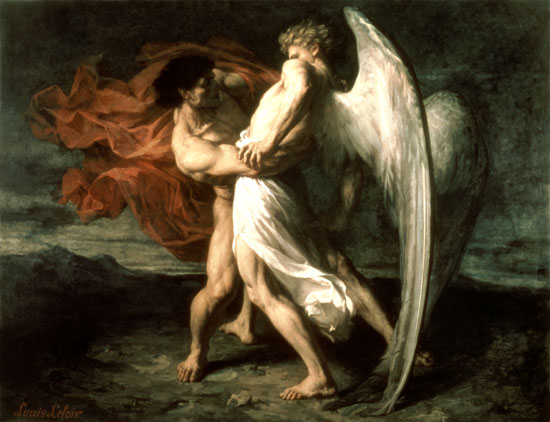
Jacob got up and took his two wives, his two maids, and his eleven children, and crossed the ford of the Jabbok. He took them and sent them across the stream, and likewise everything that he had. Jacob was left alone; and a man wrestled with him until daybreak. When the man saw that he did not prevail against Jacob, he struck him on the hip socket; and Jacob’s hip was put out of joint as he wrestled with him. Then he said, “Let me go, for the day is breaking.” But Jacob said, “I will not let you go, unless you bless me.” So he said to him, “What is your name?” And he said, “Jacob.” Then the man said, “You shall no longer be called Jacob, but Israel, for you have striven with God and with humans, and have prevailed.” Then Jacob asked him, “Please tell me your name.” But he said, “Why is it that you ask my name?” And there he blessed him. So Jacob called the place Peniel, saying, “For I have seen God face to face, and yet my life is preserved.” The sun rose upon him as he passed Penuel, limping because of his hip. Therefore to this day the Israelites do not eat the thigh muscle that is on the hip socket, because he struck Jacob on the hip socket at the thigh muscle. Genesis 32:21-33
But life in the land farther east proved to be no less complicated – for competition and conflict seemed to be a way of life for Jacob. With Esau no longer in the picture, Jacob competes now with his father-in-law Laban. First, there’s the whole marriage scandal – Jacob finds himself tricked into marrying Leah, and then ends up working another seven years to marry Rachel. But Jacob was not one to take such an insult lying down. Using a complicated method from folklore ranching, Jacob increases the number of his own goats at Laban’s expense. It’s a family business gone bad. If you wonder what an Ancient Near East prime-time soap opera in the tradition of Dallas, Melrose Place, or Scandal might look like – well, here it is. So now, once again having exceeded any goodwill available to him, Jacob needs to move on. But he’s between a rock and a hard place. He’s afraid to stay where he is, and he’s afraid to go home.
So God promises Jacob: “Return to the land of your ancestors, the land of your kindred, and I will be with you.” Of course, Jacob remains haunted by memories of Esau’s threat. Is his brother still angry? Will Esau kill him if he returns to Canaan? Still Jacob goes, sending gifts of livestock and slaves out in front of his caravan to appease any residual anger Esau might harbor. Jacob’s messengers return with an ominous report – Esau is indeed coming out to meet Jacob, and he’s bringing four hundred men with him. Is there going to be a battle, or is Esau planning to throw him a big party? Jacob isn’t sure which.
This is where today’s reading picks up. We find Jacob alone and vulnerable – having sent the rest of his family on ahead across the river. The biblical text is vague in its description of what happens next. A “man” comes to Jacob in the night and wrestles with him until the break of day. We’re not told explicitly who this man is, but when morning comes it’s clear (at least to Jacob) that Jacob has wrestled with none other than God. This image of God and Jacob wrestling may be a little disconcerting for some of us. Because if this is how God treats friends, God’s chosen ones… well, then what does that mean for the rest of us?
The God in this story seems a far cry from the God made known to us through the peaceful blond-haired, blue-eyed Jesus hanging on the walls of the church I grew up in. But the picture of God we see here is also not a stereotypically distant God who sits up in heaven on a throne dispensing rewards and punishments. This God actually wrestles with Jacob. In the lonely, anxious dark night, God refuses to either leave Jacob alone or to magically make all his problems disappear. Instead, God delves into the very heart of Jacob’s conflicted life – remaining faithful to the promise to be with him.
What’s amazing is that, even in the midst of this struggle, with Jacob wounded, scared and vulnerable, he still has the audacity to demand a blessing from God, saying: “I will not let you go, unless you bless me.” Jacob holds God’s feet to the fire – expecting, even demanding, the blessing that he’s been promised. And receive a blessing he does. It’s true that Jacob will leave this encounter with God limping. But that wound, that scar will not only be a sign of the struggle Jacob’s gone through, it will also be a sign of the blessing he’s received.
That’s the funny thing about blessings – they are rarely simple, straightforward matters. We often think we can neatly divide the things, events, and relationships of our lives into two neat categories – blessings and curses. All that makes us happy fits in the “blessing” category, while all conflict, suffering, and difficulty fit into the category of “curses.” But, as we learn from Jacob, it’s not quite that simple. More often than not, our lives are a complex mix of blessing and struggle – lines between the two often blurred, with the same event or thing or relationship crossing from one category to the other almost seamlessly. What’s striking about Jacob is the faith that he has in the midst of this complex mess that we call life. Despite all the struggle, uncertainty, and fear, he holds fast to the belief that God will indeed bless him – that the final word on his life will be a blessing, not a curse.
It’s a scene we’ll see played out again and again between Israel and her God. The “chosenness” of Israel will take them through periods of prosperity, exile, victory, conflict, and deep communion with God. But even in the depth of despair, Israel will turn her face towards God, asking “How long, O Lord, how long?” She still expects, even demands, the blessing God has promised her. Although some might see this dogged stubbornness as presumptuous or maybe even as a sign of blind denial, I believe it bears witness to a deep-seated faith in God as a God of blessing.
I’m reminded of Cardinal Joseph Bernardin, a Roman Catholic cardinal from Chicago who died in 1996. His book, The Gift of Peace, is a record of his struggles during his battle with pancreatic cancer. As he reflects on the final three years of his life, a complex mixture of joy and suffering comes into view. He is falsely accused of sexual abuse by a seminarian. The accusation is retracted, and a touching reconciliation takes place. He struggles to have a rich prayer life in the face of increasing fatigue. He relishes the beautiful relationships he has with others who are ill. In a hand-written letter penned just days before his death, Cardinal Bernardin looks back on this mixture of his life and offers up a proclamation of hope: in the words of an old saying, God can indeed write straight with crooked lines. God can take the complex mixture of our lives and, at the end of the day, pronounce a blessing on it.
All of us know that our lives don’t seem to fit into neat categories of blessings and struggles – in fact, it’s sometimes difficult to distinguish one from the other. Our lives are a complex mixture of joy and pain simultaneously. Just ask anyone who’s lost a love, parented a child, been pushed into a new transition, or been a member of a church. But here is the Good News: whatever our lives hold, God will bless our mess. Just like God blessed a scrapper named Jacob and his stiff-necked descendants, God will bless us, too. Even in the midst of pain, conflict, or struggle, we too can turn our faces toward God, hold on tight to God, and demand a blessing.
Scriptural quotation above from the New Revised Standard Version Bible, copyright © 1989 National Council of the Churches of Christ in the United States of America. Used by permission.
 An Honest Hope