
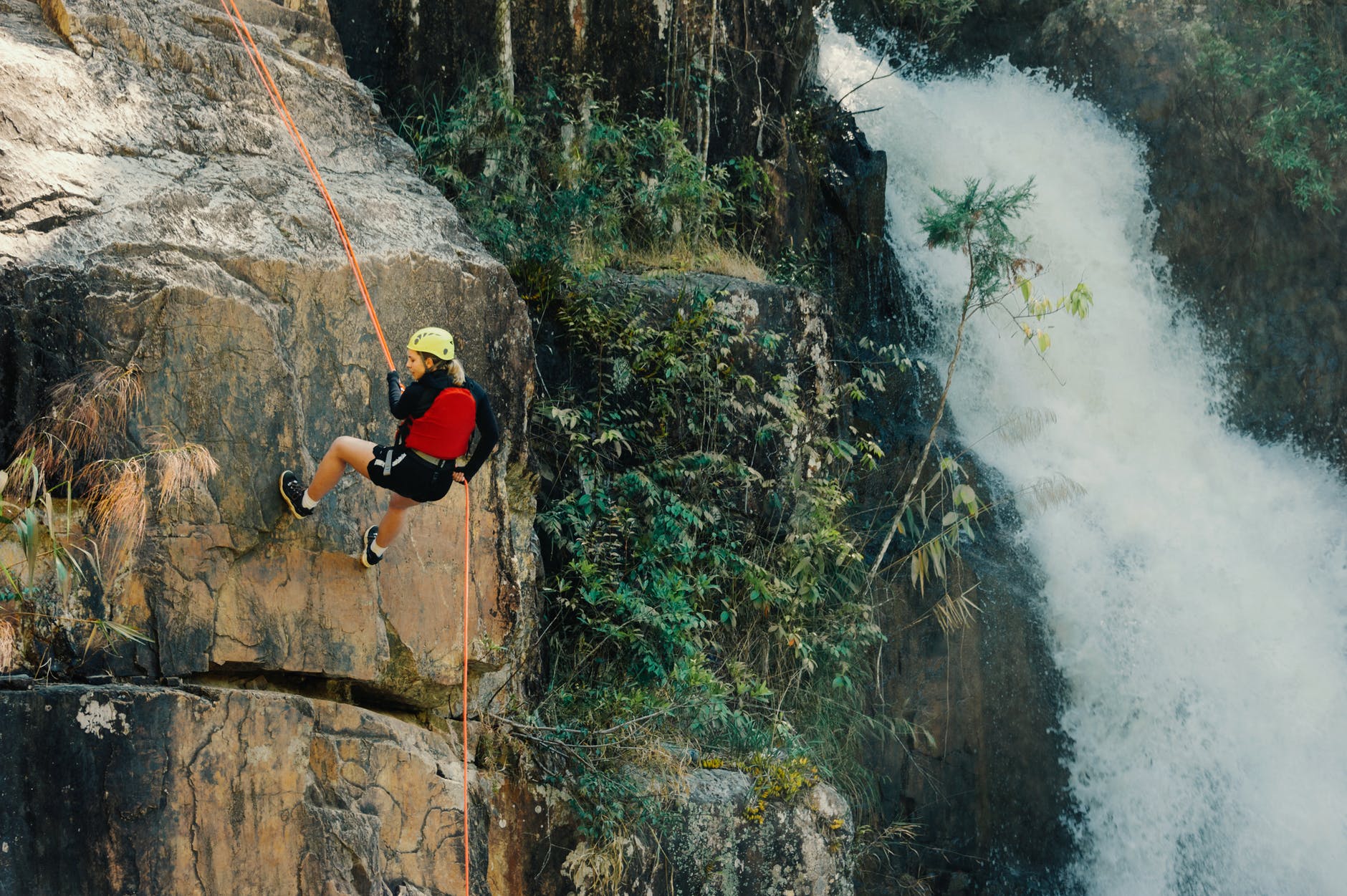
Parker Palmer tells the story of an experience he once had as part of an Outward Bound program. He was taken to the edge of a cliff, and a rope was tied around his waist—he remembers it as a “very thin” and “frayed” and “stretchy” rope. The instructor told him to back down the cliff. When he asked what he should do, the instructor merely yelled, “GO!” He went, but slammed into the first ledge—hard. The instructor said from above, “I don’t think you’ve quite got it. The only way to do this is to lean back as far as you can, because you have to get your feet at right angles to the rock face so you’ll have pressure on them.” Scared, and convinced of his own wisdom, Parker knew that the instructor was wrong—that, as he says, “The trick was to hug the mountain, to stay as close to the rock face as you can.” He tried it his own way once more—BOOM! He hit the ledge again. Finally he tried leaning back, and things started to go much better. He was making his way down the cliff when another instructor called out from below: “Parker, I think you better stop and look at what’s happening beneath your feet.” He looked down and saw a gap in the rock below him, but for the life of him he couldn’t move his feet at all to either side. He was frozen. And he had no idea how he was going to get out of the situation. His instructor yelled up that it was time for him to learn the motto of the Outward Bound Hurricane Island School: If you can’t get out of it, get into it! Suddenly he understood that there was no easy way out. If he wanted to get out of this situation, he had to get further into the situation first. So finally he began to move his feet, no matter how scared.[1]
To keep going is a hard thing to do. When the path ahead looks difficult, unsafe, or hazy, our instinct is to turn around and go back or, if we can’t go back, to grab on where we are for dear life and not let go—to cling close to the rock and not lean back, to wait for a helicopter or some other means of rescue to come and miraculously lift us out of the situation. To head further into an already scary situation seems like pure foolishness. It is akin to thinking a cross could be a source of life, or to thinking that the way to save our life is to lose it. It’s pure foolishness.
That’s exactly how Paul describes the gospel in his first letter to the Corinthians: “Has not God made foolish the wisdom of the world? … For Jews demand signs and Greeks desire wisdom, but we proclaim Christ crucified, a stumbling block to Jews and foolishness to Gentiles, but to those who are the called, both Jews and Greeks, Christ the power of God and the wisdom of God. For God’s foolishness is wiser than human wisdom, and God’s weakness is stronger than human strength.”
At the end of the fourth century, John Chrysostom wrote a homily on today’s passage from First Corinthians. He writes that to tell someone that the cross is the way to new life is like showing a desperate man being tossed about in a boat on a stormy sea an even wilder part of the sea and telling him that there lies the answer to his problems. Or it’s like a physician telling a man with wounds that his cure will come not by medicine, but by being burned again.[2] Put in those terms, it’s no wonder the image of cross is both foolishness and a stumbling block. Who wants to go further in to find the way out?
We’d rather deal with our problems in one of two ways. 1) We often tend to ignore the parts of life that aren’t working out. We live in denial; we remain frozen on the cliff and pretend in our minds that we are on a beach somewhere instead. 2) Or we keep doing what we’re doing with greater intensity in hopes that we can cling to the cliff more tightly, or maybe even scramble back over the top. Think about it. If mild conflict doesn’t solve a dilemma, we often escalate it, bringing out the big guns both literally and figuratively. We think if we do the same thing better, stronger, harder we will get the results we want—that we will find new and perfect life. It’s what some people define as insanity—doing the same thing over and over again expecting different results.
The cross reminds us that “unless a grain of wheat falls into the earth and dies, it remains just a single grain; but if it dies, it bears much fruit.” Sometimes we have to experience death to find new life; sometimes we have to let go of what we’re holding before we can grab onto the gifts God intends for us; sometimes in losing our life, we gain it…along with much more, too. The problem is that, as the English poet W.H. Auden writes: “We would rather be ruined than changed. We would rather die in our dread than climb the cross of the present and let our illusions die.”[3] And I would add that we’d rather be ruined than let many other things, besides just our illusions, die.
This week we are invited to let go of the rocks we cling to so tightly, and instead to follow Jesus to the cross. What are the things in our lives that need to die so that we can have new life? What are the things in our world that need to die in order for new life to spring up? Is the gospel just foolishness? Or is not trusting the gospel really the greater folly, the greater insanity? Jesus invites us to come and see.
[1] Parker Palmer, “Leading from Within,” Let Your Life Speak: Listening for the Voice of Vocation (Jossey-Bass: San Francisco, 2000) 82-84. Personally, I think perhaps many women learn the same lesson through childbirth. There’s no getting out of the situation except by going through it!
[2] St. John Chrysostom, Homily IV in Homilies on First Corinthians.
[3] As quoted in Richard Rohr, Breathing Under Water (Cincinnati: Franciscan Media, 2011) 6.
 An Honest Hope