
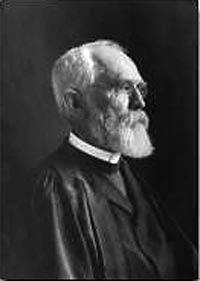
“Be where your hands are.” It’s a common saying in twelve-step programs. It means be fully present where you are; make the right choice in this moment. Just as Emily Dickinson once wrote “Forever is composed of nows,” most twelve-step programs might say “Recovery is composed of nows.” Or even “Salvation is composed of nows.” The late Episcopal theologian William Porcher DuBose would agree.
Who Is William Porcher DuBose? A Brief Biography
Wiliam Porcher DuBose has been called by some “the most creative Episcopal theologian to have ever lived,” and we in the Church remember him on August 18th. He was born on April 11, 1836 in Winnsboro, South Carolina, and grew up nearby on his father’s plantations of Farmington and Roseland – he was formed and shaped in the crucible of wealth earned at the expense of slave laborers. DuBose completed high school at the Citadel, where he underwent a conversion experience; he then attended the University of Virginia before entering the diocesan seminary in Camden, South Carolina. After a year in seminary, he joined and served the Confederacy, during which time he was wounded three times and held as a prisoner of war. On furlough in 1863, he married his first wife, Nannie Peronneau, with whom he would later have two daughters and two sons.
After discharge from the army, DuBose was ordained to the diaconate and assigned as a chaplain for the Confederacy. Following the war, he served two parishes in South Carolina before moving to Sewanee in 1871 to become chaplain and professor of moral science. In his years on the mountain, he taught courses in biblical studies, languages, ethics, homiletics, and systematic theology. But while his life in academics began to flourish, his personal life during his early years at Sewanee held significant loss. Nannie died in 1873, and their second son Samuel died a year later. DuBose would go on to marry Maria Louise Yerger in 1874, a marriage which lasted until her death in 1887.
DuBose organized the first Theological Department at Sewanee, formally established in 1878; it would later become the School of Theology. He served as the school’s second dean from 1894 until he retired in 1908. In teaching, DuBose found his true calling; for not only did his students find themselves changed through the encounter, but DuBose found himself shaped by it as well. A reunion of his students was held August 2-6, 1911, and DuBose later wrote of the occasion: “When I looked into the face of that body of men, representing all of the forty years of my service, I felt all that I could only imperfectly say: that if they felt that in their four years with me that I had been something to them, I felt that in my forty years with them they had been everything to me: if, so far as human agency can go, I had in a little measure been the making of them, they had in far fuller measure been the making of me.”[1] This statement embodies the mutuality and progressive becoming that marks DuBose’s entire theology.
William Porcher DuBose died in Sewanee on August 18, 1918 at the age of eighty-two.[2] He left behind a legacy of theological writings, including seven books: The Soteriology of the New Testament (1892), The Ecumenical Councils (1896), The Gospel in the Gospels (1906), The Gospel According to St. Paul (1907), High Priesthood and Sacrifice: An Exposition of the Epistle to the Romans (1908), The Reason of Life (1911), and Turning Points in My Life (1912).
Salvation in Process: A Theology of Now
So, what about DuBose’s theology? Well, DuBose describes God’s immanence, God’s presence in the world, as the Reason and Life that dwells within all creation – a presence that lures, guides, and invites each thing to achieve its full potential (the end for which it was made). For DuBose there is no discontinuity between the natural and supernatural; the goal of each human being is to find or know himself or herself and, moreover, to find himself or herself in God.[3]
This end was revealed and accomplished in Jesus, and yet (reminiscent of the Mission Accomplished sign behind George W. Bush on the USS Abraham Lincoln) the incarnation is not complete. Dubose writes: “[Christ] was the End and Heir of the world, inasmuch as He was its reason revealed, its meaning interpreted, its purpose accomplished. But in saying this, let us remember that the Christ is still only in process: Jesus is coming still, and yet to come. The Body of His incarnation was not alone His flesh, but all flesh. Jesus was not only Man, but all men [and women].”[4]
Almost all wonderful theologians border on heresy, and it is no different for DuBose. Not only did he claim that Christ is still in process, but he was also accused by some of emphasizing Jesus’ humanity at the expense of his divinity. According to DuBose, the humanity of Jesus was made one with God over the course of his life, through every action and every choice that brought “death to sin and life to God.”[5] In other words, Jesus became the Son of God through a lifetime of “nows.” And we come to know ourselves in God in the same way – through a process that takes place over time, a lifetime of individual choices and actions, a lifetime of nows.
That’s why the incarnation – the holiness, righteousness, and at-one-ment with God for which humanity was made – is realized slowly in the world. The incarnation depends upon our choices and love and actions, and so we can thwart the process; we can fail to reach the potential within us. For God refuses to force salvation upon us, but honors our freedom, creativity, and self determination. DuBose explains it this way:
That God has endowed us by nature with the faculty and capacity for light; that He Himself in the world as its life is, as such, its light;– does not dispense us from the necessity of coming to the light by an act and process of our own. He gives us light and life only through our own seeing the light and living the life. All rational moral, spiritual creation is creation through and by ourselves; God does nothing in a Self that is not also the doing of the self. That is the condition and law of personality; anything done merely upon us, that is not also our own doing, that is instead of our own doing, or that saves and spares us the doing, is at the cost or expense of us; it displaces and annuls the personality which is the one object and aim.[6]
For DuBose, salvation is a long sacrifice freely-given; it is a process, a string of faithful “nows” ending in a new creation.
DuBose in a World of Charlottesville and Barcelona
I wonder what DuBose would think and say if he had been standing in the park in Charlottesville on August 12th – with the statue of Robert E. Lee, the white supremacists, and the counter-protesters. Would he see his time in the Confederacy as thwarting the full presence of God in the world? Would he mourn the moments when he chose something other than life and love at its fullest?
And what of Heather Heyer? In standing on the side of those marginalized by the color of their skin, the religion they follow, or the partner they choose, she brought the incarnation closer to its completion. But while her own faithful choice on August 12th may inspire others and live on through their actions, a death at 32 years of age means a million lost moments – lost opportunities for Heather to choose love over hate again and again and again. And what about the thirteen people killed in Barcelona?
DuBose writes: “We complain that the world is made what it is, forgetting that it is not made but still in the making, and that it is here for us to make it what it ought to be, and that it is no better only as we do not make it better.”[7] But terror and tragedy and hate spring up here and there, and our attempt to respond to each event may seem like a futile game of whack-a-mole.
Into this discouraged world come the wise words of twelve-step programs: Be where your hands are. Be here; see the darkness here, but also see the light in all its potential; make the right choice in this moment. Salvation, like recovery, doesn’t happen in an instant but is a long sacrifice, a string of faithful “nows.” It is a process, and every moment is another chance.
Perhaps I would do well to remember that when I think of the KKK members and the Neo-Nazis that marched in Charlottesville, or the terrorists who drove a van into a crowded pedestrian street in Barcelona. They are also people in the making, living in a world in the making. Like all of us, they are in process, and each tick of the clock brings them another chance to choose life just as surely as it does the rest of us. Just as surely as it did William Porcher DuBose.
[1] William Porcher DuBose, Turning Points in My Life, (New York: Longman’s, 1912) 9.
[2] The biographical information in this section comes from the following sources: Robert Boak Slocum, The Theology of William Porcher DuBose (Columbia, South Carolina: The University of South Carolina Press, 2000) 1-19, and Jon Alexander, ed., WIllliam Porcher DuBose: Selected Writings (New York: Paulist Press, 1998) 5-27.
[3] Finding ourselves in God requires a relationship between us and God. Any subjective relationship demands that the parties transcend one another, because to share a bond of mutual knowledge, love, and will is to know the other as separate from (or outside of) ourselves. This is the transcendent God we find in DuBose’s theology.
[4] William Porcher DuBose, The Reason of Life (New York: Longman’s, 1911) 44.
[5] William Porcher DuBose in The Soteriology of the New Testament as quoted in Donald S. Armentrout, A DuBose Reader: Selections from the Writings of William Porcher DuBose (Sewanee, Tennessee: University of the South, 1984) 67.
[6] DuBose, The Reason of Life, 38.
[7] DuBose, The Reason of Life, 95.
 An Honest Hope