

Andrewes exercised considerable influence for many years both in the Church of England and at court. He served as chaplain to the Archbishop of Canterbury, as well as to Queen Elizabeth I. Although Andrewes was offered two positions as bishop under Queen Elizabeth I, he turned them both down. He continued to be held in high regard during the reign of King James I and finally succombed to ordination as a bishop in the Church, becoming Bishop of Chichester in 1605, of Ely in 1609, and of Winchester in 1619. In 1616, he narrowly missed becoming the Archbishop of Canterbury.
Lancelot Andrewes was a brilliant scholar. It is said that he was fluent in fifteen languages, and that he might “have served as an interpreter general at the confusion of Tongues,” or Pentecost. It makes perfect sense, then, that he was one of the scholars appointed to produce the Authorized Version of the Bible, or the King James Version as it has come to be known.
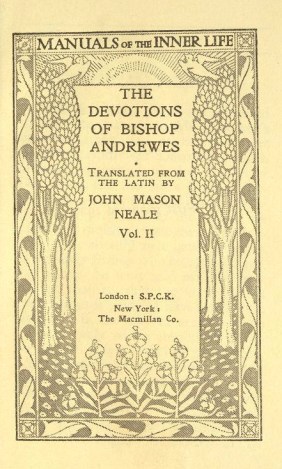
Although much of his fame during his own lifetime came from his sermons, let us not imagine in Andrewes only a dry, cerebral faith. It is important to note that Andrewes is also well known for his spiritual purity and dedication. Preces Privitae (or Private Devotions) is a collection of his own personal devotions composed mainly in Greek, a window into the five hours each day the bishop is said to have spent in prayer. Some claim that his silent instensity, simplicity, and ascetic habits caused even the King and members of court to curtail their questionable behavior when he was present.
Lancelot Andrewes died on September 25, 1626 at Southwark in Surrey.
Andrewes’ Sermons
Lancelot Andrewes preached regularly at court on high feast days such as Christmas, Easter, and Pentecost. His sermons reveal a depth in the biblical text that few preachers ever dig long enough or thoroughly enough to reach. T.S. Eliot said of Andrewes’ sermons: “Andrewes takes a word and derives the world from it; squeezing and squeezing the word until it yields a full juice of meaning which we should never have supposed any word to possess.”[1] A book of 96 of his sermons was published in 1628 and remains an Anglican classic.
The sermons of Lancelot Andrewes’ are peppered with quotations in Latin and Greek. The multilingual quotations wrought angst among those who opposed his style of preaching, but Andrewes almost always went on to translate these phrases in the course of his sermon. And although his use of Latin and Greek may have been tinged with hubris, it more often resulted from his respect for the texts themselves. “For my part,” Andrewes explained, “I wish no word ever narrowed by a translation, but asmuch as might be, left in the latitude of the Originall tongue.” [2]
As dense as his sermons are to push through at times, the effort is rewarded with vivid imagery that lingers in the mind long after the final “Amen.” For example, Andrewes’ Sermon 11 of the Nativitie (Christmas 1616) explores, for a full twenty-six pages, Psalm 85:10-11:
Mercie and Truth shall meet: Righteousnesse and Peace shall kisse one another. Truth shall budde out of the earth; and Righteousnesse shall look downe from Heaven.
The four virtues are bound together in the simplicity of God, Andrewes explains, and they had been joined in us as well until the first lie was told and truth vanished from the earth. Ever since, the virtues have been separated: two for us (Mercy and Peace) and two against us (Truth and Righteousness). Andrewes then portrays a beautiful, earthly reunion of these virtues in the birth of Christ: Mercy awaiting the first utterance of Truth that is Christ, Righteousness looking down from heaven with favor, and Peace the link between them all. In other words, Christmas becomes a meeting of four virtues as well as that of two natures.
Picking up on the language of the psalm, Andrewes depicts the role of Righteousness as that of a forlorn lover waiting at the window to be united with Truth:
Thus when Truth, from the earth; then, Righteousnesse, from heaven. Then: but not before. Before, Righteousnesse had no prospect, no window open this way. She turned away her face; shut her eyes; clapped to the casement; would not abide so much as to look hither at us, a sort of forlorne sinners: not vouchsafe us once the cast of her eye. The case is now altered. Upon [the sight of Christ’s birth], she is not onely content, in some sort, to condescend to do it, but she breaks a window through, to do it. …
But then within a verse after, not only down she looks but down she comes. Such a power attractive is there in this birth. And comming, she doth two things. 1.Meets first; for upon the view of this birth they all ran first and kissed the Son. 2. And that done, Truth ran to Mercie and embraced her; and Righteousnesse to Peace, and kissed her. They that had so long been parted, and stood out in difference, now meet and are made friends; howsoever before removed, in ortu Veritatis obviaverunt sibi; howsoever before estranged, now osculat sunt [3]
Andrewes never lets the text remain on a dusty page, but always creates from it a lens through which our own lives are read. Having now met in Christ, the four virtues, through the work of Christ, are free to meet in us as well. Christmas begins our redemption.
In Sermon 4 of the Holy Ghost: Whit-Sunday 1611, Andrewes reflects on John 16:7, on the incredibly distressing news Jesus gives the disciples before his crucifixion:
It is expedient for you that I goe away: For if I goe not away, the Comforter will not come into you; but if I depart, I will send Him unto you.
Andrewes spends the entire sermon in the tension of these words, not skipping over at all the disciples’ pain at the prospect of losing Jesus, not skipping over the loss inherent in the coming of the Holy Spirit. In his reflection, he uses the image of two buckets that will forever be associated in my mind with the tenuous balance between Easter and Pentecost:
We see a necessitie of His comming: but, we see no necessitie of Christ’s going. Why not Christ stay, and yet He come? Why may not Christ send for Him, as well as send Him? Or, if He go, come againe with Him? … Are they like two buckets; one cannot go downe, unlesse the other go up? [4]
Andrewes remains focused in his sermons on what he considers to be the essentials of the Christian faith, the Mysteries themselves—the Incarnation, the Resurrection, the coming of the Holy Spirit at Pentecost—the events through which God enters into the history of the world so that the world might be transformed. After leading us through a labyrinthine narration of the Mysteries of the Church, each sermon of Lancelot Andrewes ends by directing us towards the Eucharist—toward a transformative encounter with mystery itself.
Perhaps we would do well in our day to periodically revisit the sermons of Lancelot Andrewes, for the characteristics that mark his sermons are the same ones that form a faithful, life-changing spiritual journey: the juxtaposition of patience with fierce longing. The careful attention and passionate devotion with which Andrewes approaches a single verse of scripture is a sign to us of how to approach our spiritual life—immersing ourselves in the Mysteries, working out our salvation with perseverance, encounter, imagination, and a willingness to be transformed over and over again.
[1] T.S Eliot, For Lancelot Andrewes: Essays on Style and Order (Faber and Gwyer, 1928) 24.
[2] Lancelot Andrewes in Lancelot Andrewes: Sermons, edited by G.M. Story (Oxford: Clarendon Press, 1963) xxxviii.
[3] Story, 65.
[4] Story, 251.
As always, I am indebted to Tony Baker for my love of, and understanding of, Lancelot Andrewes.
 An Honest Hope