
“Being in a hurry. Getting to the next thing without fully entering the thing in front of me. I cannot think of a single advantage I have ever gained from being in a hurry. But a thousand broken and missed things, tens of thousands, lie in the wake of all the rushing…. Through all that haste I thought I was making up time. I turns out I was throwing it away.”
—Mark Buchanan, in The Rest of God: Restoring Your Soul by Restoring Your Sabbath
In the last post I wrote about stability and conversion, but in this one I want to begin with the third Benedictine vow – obedience. The word obedience comes from the Latin word oboedire, which shares a common root with the word audire. Think about the word “audiology.” In the evolutionary history of words, obedience and audiology and audience all share a common origin. Esther de Waal, who has written about Benedictine life, says that when we talk about obedience, we are talking about hearing God and then showing that we have heard by acting accordingly. In other words, obedience begins with listening.
In my experience, God doesn’t usually yell. In fact, to hear God I usually have to listen – to pay attention. God is at work in every place, we just need to develop the eyes to see, the ears to hear, the sense of touch to feel, and the heart to know.
Perhaps one reason that it takes practice to recognize God in the world around us is that we’ve been led to believe in subtle ways that God doesn’t really live in the world outside the doors of our church. In subtle ways we have been taught that God doesn’t really exist everywhere. Think about it. As soon as something seems sacred to us, we often build a church there to mark it as holy – Church of the Holy Sepulchre over the place Jesus is believed to be buried, Church of the Holy Nativity at the site where Jesus is believed to have been born, the Basilica of the Immaculate Conception over the grotto where the healing water runs in Lourdes, France. And just think of the first impulse Peter had after seeing witnessing the transfiguration of Jesus: “Master, it is good for us to be here – let us make three dwellings: one for you, one for Moses, one for Elijah.” Peter wants to start a building campaign! As soon as something seems sacred for us we want to separate it from everything else. But maybe this tendency we have to put walls around the holy and designate it as such isn’t always such a great thing…
In An Altar in the World, Barbara Brown Taylor writes:
As important as it is to mark the places where we meet God, I worry about what happens when we build a house for God. I am speaking no longer for the of the temple in Jerusalem but of the house of worship on the corner, where people of faith meet to say their prayers, because saying them together reminds them of who they are better than saying them alone. This is good, and all good things cast shadows. Do we build God a house so that we can choose when to go see God? Do we build God a house in lieu of having God stay at ours? Plus, what happens to the rest of the world when we build four walls – even four gorgeous walls – cap them with a steepled roof, and designate that the House of God? What happens to the riverbanks, the mountaintops, the deserts, and the trees? What happens to the people who never show up in our houses of God?
The people of God are not the only creatures capable of praising God, after all. There are also wolves and seals. There are also wild geese and humpback whales. According to the Bible, even trees can clap their hands. Francis of Assisi loved singing hymns with his brothers and sisters – who included not only Brother Bernard and Sister Clare, but also Brother Sun and Sister Moon. Francis could not have told you the difference between “the sacred” and “the secular” if you had twisted his arm behind his back. He read the world as reverently as he read the Bible. For him, a leper was as kissable as a bishop’s ring, a single bird as much a messenger of God as a cloud full of angels. Francis had no discretion. He did not know where to draw the line between church and the world. For this reason among others, Francis is remembered as a saint.
Of course, Francis also built a church. In a vision he had, as vivid as Jacob’s vision of the divine ladder, God called upon Francis to rebuild the church. Unsure what church God meant, Francis chose a ruined one where he lived. He recruited all kinds of people to help him build it. Some of them just came to watch, and before they knew it were mixing cement. Others could not lift a single brick without help, but that worked out, since it led them to meet more people than they might have if they had been stronger. To most of them, building the church became more important than finishing it. Building it together gave people who were formerly invisible to each other meaning, purpose, and worth. When it was done at last, Francis’s church did not stand as a shelter from the world; it stood as a reminder that the whole world was God’s house.
I knew that when I was young, and then I forgot. …
Human beings may separate things into as many piles as we wish – separating spirit from flesh, sacred from secular, church from world. But we should not be surprised when God does not recognize the distinctions we make between he two. Earth is so thick with divine possibility that it is a wonder we can walk anywhere without cracking our shins on altars. [1]
Barbara Brown Taylor’s refusal to acknowledge the difference between sacred and secular convicts me to my core. As a priest, there are days when I rush through the church building, aware of all the “holy” things I think are mine to do – my priorities tilted, off kilter. But, even more, I rush through the world outside the church doors. And, in the process, I risk missing so many manifestations of God in the world – I end up missing so many burning bushes, so many theophanies.
Maybe the same was true for Moses on most days. Moses must have walked by that bush numerous times before while watching his father-in-law’s sheep, the bush not even registering in his consciousness. I wonder if it had ever burned with fire before the day we read about in scripture. Was the day Moses received his call the first day the flames of God ever engulfed its branches, or was it just that this was the first time Moses noticed the burning bush and so turned aside and came closer? Was this just the first time the blazing branches drew Moses off his usual path enough to hear God speak to him, “Remove the sandals from your feet, for the place on which you are standing is holy ground”?
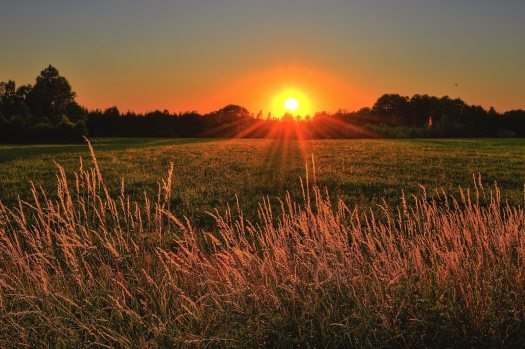
The house we lived in when we first moved to Clarksville eighteen years ago had its own burning bush – the kitchen window. Not the pretty bay window that looked out on the backyard, and not one of the full-length windows that spanned almost from floor to ceiling. Instead, the window that best revealed the presence of God was a simple window located over the sink; it measured approximately 30 X 36 inches. Sometimes this window framed a dark gray sky full of ominous clouds. Most of the time, it was just ordinary – something you could pass by without giving a second glance. But once in a while this westward-facing window would glow bright pink or deep red or an almost fluorescent orange with the unobstructed rays of the sunset. If this happened while we were preparing dinner, we would stop in our tracks. If one of us were washing dishes, we often called the other to come and see. But I’m sure that most of the times that window burned with the beauty of God, we missed it.
After all, most of our experiences of beauty in this world are fleeting, and it seems that we could just as easily miss them altogether. An accidental glance over the shoulder reveals neon colors in a sunset; the winter sun shining at just the right angle through red leaves makes them glow like hot coals; a momentary look of joy makes a face absolutely radiant. Beauty rarely forces herself on us; we have to be attentive and ready to encounter her.
The same is true of our encounters with God – after all, burning bushes are always found on the side of the road and not right in front of us. God rarely forces Godself on us. That’s why experiencing the presence of God takes a certain reverence. True, God is always with us, even in the most ordinary and unlikely places, but we can’t manufacture encounters with God. To see God, we have to walk through life expectantly, waiting patiently for a flicker that on closer inspection reveals nothing less than the glory of God.
But that blend of anticipation and waiting, that reverence, is foreign to so many of us. In our world today we tend to be so focused on work, accomplishments, social engagements, and our to-do lists that we miss out on the deep beauty that surrounds us and the God that enfolds us. We don’t have the patience to let something reveal itself to us. Google gives us every fact we search for immediately; business magazines tell us that to be productive we need to schedule things in fifteen minute increments; we grab life by the horns instead of letting it move toward us at its own speed.
The truth is that sacraments can’t be contained by the four walls of a church building. Life is Eucharistic to its core, and everywhere is an altar rail.
Part of learning about our own spiritual geography is about taking time to notice the how the Holy Spirit is at work in our midst. When was the last time we looked for God in our own town, in our own activities, in our own backyard? When was the last time we sat on a bench in the middle of the mall and watched the faces pass by with no agenda of our own? Or lay down in the grass and basked in the warmth of sunlight on our face? Or risked being fully present to the gentleman asking for money on the sidewalk? Or took the time to find out the name of the woman who delivers our mail every day? When was the last time we were completely vulnerable to the world around us, allowing ourselves to be caught off-guard by the place and people and ways in which God might reveal God’s heart? When was the last time we took off our shoes and, with reverence, walked the earth?
FOR FURTHER REFLECTION
- Close your eyes and imagine a place you see every day. How much can you remember about it? The sounds, smells, sights, feel, and taste – have you paid attention to them?
- As you eat, consider the larger world that is part of the food on your plate. The deep earth, the sun, the rain that falls from the sky, the hands that have picked or kneaded or arranged the food, each moment that nourished it. With every bite, feel gratitude for all that gave rise to this this meal.
- In what ways do we separate the world into “secular” and “sacred”? Where can you find God in what we often deem “secular”?
- Where are the “altars” or sacred places in your own world?
[1] Barbara Brown Taylor, An Altar in the World: A Geography of Faith (New York: HarperCollins, 2010) 9-10, 15.
 An Honest Hope